How it started
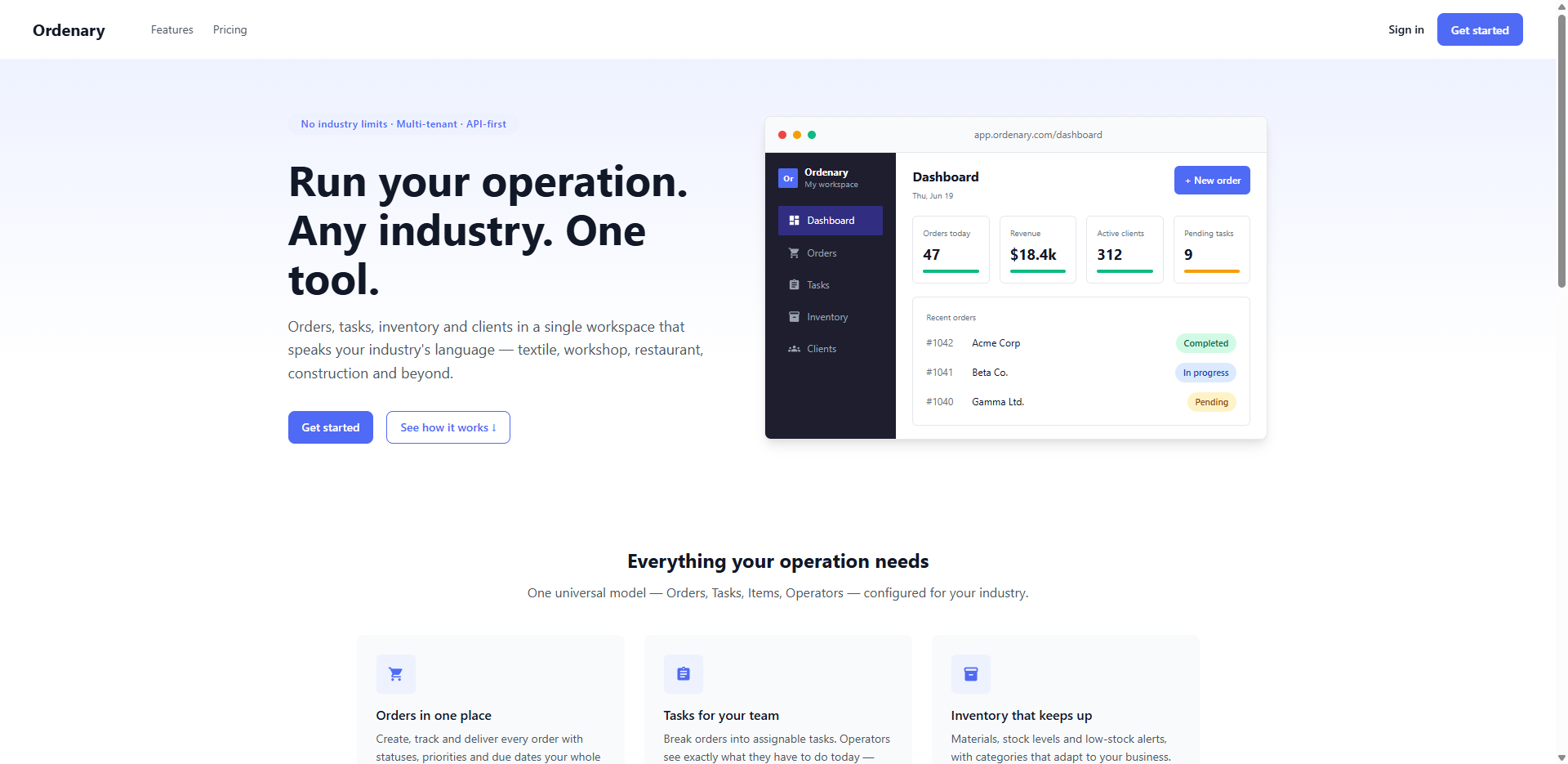
Telas 3B was built for one textile company. While maintaining it, the same shape kept showing up — orders move through stages, operators pick up tasks, inventory gets tracked — regardless of what the business actually made or sold. Ordenary is what happens when that observation becomes the product: instead of a system for one client, a universal Order/Task/Item/Operator/Client core that each workspace relabels to its own industry through an IndustryProfile — textile, workshop, restaurant, construction, and beyond.
What it does
- Multi-tenant workspaces, each speaking its own industry’s language over the same underlying model
- Orders, tasks, inventory and clients managed from a single dashboard, with role-based views for admins and operators
- Reports, notifications, and low-stock alerts built on top of the same core data
- Firebase authentication in front of a Spring Security-protected API
Tech stack
Frontend: React 18, TypeScript, Vite, Zustand, Firebase Auth, Axios, Recharts — mid-migration from a legacy BEM stylesheet architecture to Tailwind CSS, component by component.
Backend: Java 17, Spring Boot 3, Spring Security, Spring Data JPA, PostgreSQL with Flyway migrations, Bucket4j rate limiting.
Testing: Vitest, 290 tests across 62 files; Storybook for the component library.
Infra: Docker Compose for PostgreSQL + backend.
Where it’s at
Still in active development — not deployed anywhere yet. The frontend runs locally against a Dockerized backend while I work through the parts a single-client project like Telas 3B never forced me to solve: multi-tenancy, an industry-agnostic domain model, and a test suite that has to hold as the surface area grows. Production deployment is next.